
- Времена группы Simple Present Perfect, Present Continuous, Present Perfect Continuous, Past Continuous и Past Perfect
- Упражнения на Future Simple и условные предложения
- Упражнения на Passive Voice в Present Simple, Past Simple и Future Simple
- Упражнения на перевод в разных временах
- Вы выполнили упражнения на повторение (intermediate). ответы даны ниже.
- Помогите пожалуйста. упражнение 2. поставьте глаголы в нужном времени активного залога. sandy (read) historic books every day. w
- Поставьте глаголы в нужном времени активного залога. срочно —
- Употребите глагол в скобках в нужном времени активного или пассивного залога. затем переведите предложения. — киберпедия
- Упражнение 1. поставьте глаголы в нужном времени активного залога. sandy (read) historic books every day. what liza (do) now? —
Времена группы Simple Present Perfect, Present Continuous, Present Perfect Continuous, Past Continuous и Past Perfect
Просмотрите таблицу «Основные времена в английском языке» и дополните ее.
Упражнения на Future Simple и условные предложения
Упражнение 11.Раскройте скобки, употребляя глаголы в нужном времени.
1.Before you (to cross) the park, you will come to a supermarket. 2. When you (to cross) the park, you will see the hospital. 3. If you (to translate) this article into Russian, I will use it in my report. 4. If you (not to hurry), you will miss the train. 5. If it (to rain), we won’t go to the country. 6. When my friend (to come) to St. Petersburg, we will go to the Russian Museum. 7. What will you be doing when he (to come) to your place? 8. I will be able to translate this article if you (to give) me a dictionary. 9. You will have to work hard at home if you (to miss) the lesson. 10. Where will you go when you (to come) to London? 11. The child won’t be healthy if you (not to give) him much fruit. 12. I won’t have dinner before mother (to come) home.
* * *
Упражнение 12. Раскройте скобки, употребляя глаголы в Present Simple или Future Simple. (Все предложения относятся к будущему.)
- If I (to stay) some more days in your town, I (to call) on you and we (to have) a good talk.
- He (to go) to the Public Library very often when he (to be) a student.
- As soon as I (to return) from school, I (to ring) you up.
- You (to pass) many towns and villages on your way before you (to arrive) in Moscow.
- I (to stay) at home till she (to come). Then we (to go) to the theatre if she (to bring) tickets.
* * *
Упражнения на Passive Voice в Present Simple, Past Simple и Future Simple
Упражнение 13.Раскройте скобки, употребляя глаголы в пассивном залоге.
- Yesterday I … a lot of money to do the job. (to pay)
- This machine must … every time you use it. (to clean)
- The flowers should … in a warm sunny place. (to keep)
- Smoking … in this restaurant. (not to allow)
- Miss Bennet… about the party yesterday. (to tell)
- This film … usually … on TV. (to show)
- The carpets … every day. (to clean)
- I hope I… for the college football team. (to choose)
* * *
Упражнение 14. Замените действительный залог страдательным.
- Alexander Bell invented the telephone in 1876.
- The Chinese invented paper.
- They invented photography in the 1840s.
- The French government gave the Statue of Liberty to the American people.
- They make Volkswagen cars in Germany.
- Columbus discovered America.
- They discovered penicillin in 1928.
- They talked much about that problem.*
- They will advertise the product on TV.
- His parents have bought him a new bicycle.
* * *
Упражнение 15. Замените действительный залог страдательным.
- A waiter took away the dish.
- They took books to the classroom.*
- Mum decorates the kitchen every year.
- Tourists photographed lots of monuments.
- Millions of people watch this TV programme.
- Last night someone broke into the house.*
- They sent for a doctor.*
- They grow bananas in Africa.
- They built the Eiffel Tower in 1899.
- They invented the steam engine in 1769.
* * *
Упражнение 16. Найдите ошибки и исправьте их.
1.Who was made the report? 2. Who was founded the university? 3. What the film called? 4. When the world’s first film was shown? 5. Where the first European university situated? 6. When the first Moscow metro station built? 7. When Shakespeare wrote his plays? 8. How the bank robber arrested yesterday? 9. When you was born? 10. What is the dress make of?
* * *
Упражнение 17. Раскройте скобки, употребляя глаголы в Present Simple, Present Perfect, Past Simple, Future Simple. Используйте Активный и Пассивный залог.
- I am sure they …. (not to build) the cottage next month.
- The parents …. (to meet) by their sons tomorrow.
- The patient …. (not to hear) well.
- I …. (to buy) this gadget yet.
- … the Brooks …. (to make) firework yesterday?
- What …. the teacher …. (to mean) when he says: ‘Good for you’?
- He always …. (to keep) money in the bank.
- The letter …. (to send) at 6 o’clock yesterday.
- Where …. the road …. (to lead) to?
- When…… the leaves …. (to fall) down?
- They …. (to ride) a horse since morning.
- Girls never …. (to shake) hands with each other.
- The Brooks’ car …. (to steal) last week.
- A lot of money ….. (to spend) on food every day.
- The parcel ….. (to take) to the post office tomorrow.
- I would like …. (to understand) English people very well.
- When …. you …. (to tell) them the news?
- Look! The dog …. (to swim) in the pond.
- That student ….. (not to write) the test yet.
- What …. you …. (to say)? I can hardly hear you.
Упражнения на перевод в разных временах
Упражнение 18. Переведите на английский язык.
- Когда я шел на работу, я встретил своего старого товарища, но (не смог) не поговорил с ним, так как он очень торопился.
- Что ты делала вчера в это время? Я звонила тебе дважды (twice), но никто не ответил. — Я готовила обед.
- На каком языке говорит этот иностранец? — Он говорит на немецком языке.
- Этот писатель прекрасно говорит на четырех языках.
- Мой брат играл на пианино, когда отворилась дверь и кто-то позвал его тихим голосом.
- Я знаю, что, когда мы приедем к Борису, он будет еще спать.
* * *
Упражнение 19. Переведите на английский язык.
- Она очень занята с тех пор, как она вернулась в город.
- Я не видела Петровых с тех пор, как они переехали на дачу. (move to)
- Наконец-то мы получили письмо от брата. Мы не получали от него писем три месяца.
- Она очень изменилась с тех пор, как мы видели ее в последний раз.
- Кто навестил вас вчера? — Друзья моего сына.
- Где вы были вчера? — Я ходил в кино.
- Когда вы пришли домой? — Я пришел поздно.
- Вы любите играть в шахматы? — Да, но я редко играю в шахматы (в этом году). В прошлом году я часто играл в шахматы.
- Я никогда об этом не слышал.
- Вы уже переехали на новую квартиру?
* * *
Упражнение 20. Переведите на английский язык.
- Петр не говорил мне об этом.
- Вы когда-нибудь видели этого писателя?
- В этом месяце я прочитал три книги.
- Я не видел моего брата последнее время.
- Вы когда-нибудь были в Лондоне? — Нет, но я поеду туда в этом году.
- Его дочь закончила университет и работает за границей сейчас. — Когда она закончила университет?
- Я приехала вчера поздно вечером, поэтому я не пришла навестить вас.
- В детстве я жил в Санкт Петербурге, поэтому я хорошо знаю этот город.
- Вы уже видели Анну? — Да, она недавно приходила к нам.
- Сколько лекций по истории у вас было в этом году?
* * *
Упражнение 21. Переведите на английский язык.
- Студенты пишут контрольную работу уже почти два часа. Время подходит к концу, а только двое сдали работы.
- Утро было солнечное, но с одиннадцати часов погода изменилась, и теперь идет дождь.
- Шел очень сильный снег, и я не смог разобрать номер троллейбуса. Когда я проехал уже несколько остановок, я понял, что ехал не в том направлении.
- Я упорно звонил вам с четырех часов, и ваш номер был все время занят.
- Художники работают с утра, так как мы хотим подготовить плакат сегодня вечером.
- Пока мы шли со станции, он успел мне рассказать всем, что произошло со времени моего отъезда.
- Уже прошло пять лет, как мы работаем над этой проблемой.
- Когда я пришел, он уже вернулся и сидел у камина, просматривая журнал. (look through)
- Неужели эта книга все еще у него? Сколько времени он ее читает?
- Они обсуждают этот вопрос уже два часа и не пришли к какому соглашению.
Вы выполнили упражнения на повторение (intermediate). ответы даны ниже.
ОТВЕТЫ
Помогите пожалуйста. упражнение 2. поставьте глаголы в нужном времени активного залога. sandy (read) historic books every day. w
Поставьте глаголы в нужном времени активного залога. срочно —
Ответ:
1. Sandy reads historic books every day.
2. What is Liza doing now? Liza is writing a letter.
3. Kate met with her friends 10 minutes ago.
4. When will Jill come to the office tomorrow?
5 Simon bought a ticket yesterday.
6. Mary was reading the text while Ann was traslating the words.
7 Charlotte was doing her homework while her friend Megan was reading the text.
8. The Ivanovs went to the Hermitage last week
9. The sun hasn’t risen yet, but the sky gets lighter every minute.
10. Sandy didn’t go to the shopping mall yesterday.
11. Sandy will go to the shopping mall tomorrow./ Sandy is going to the shopping mall tomorrow (если действие запланировано заранее)
12. Samuel has just gone out.
13. How long has Gretta been driving a car? Gretta has been driving for 5 years
14 When did Alice go to the cinema? Alice went to the cinema last Sunday.
Объяснение:
Употребите глагол в скобках в нужном времени активного или пассивного залога. затем переведите предложения. — киберпедия
1. Не … (to be interested) in history since his childhood.
2. The positive results … (to be obtained) until a more powerful apparatus was installed.
3. They … (to determine) the main properties of the substance.
4. The explanation of these strange facts … (to be given) yet.
5. He … (to be offered) a very interesting job at that Institute.
6. All the necessary information … (to be stored) in the computer.
7. After careful consideration your report … (to be published) in one of the forthcoming issues of the journal.
8. The problem of the future of human civilization on the Earth is … (to be studied) by the scientists throughout the world.
СОГЛАСОВАНИЕ ВРЕМЕН (SEQUENCE OF TENSES)
Если глагол-сказуемое главного предложения стоит в настоящем времени, то глагол-сказуемое придаточного предложения может стоять в любом, требуемом по смыслу времени.
| He says that Он говорит, что | he is busy now. он занят сейчас. he was busy yesterday. он был занят вчера. he will bebusy tomorrow. он будет занят завтра. |
Если глагол-сказуемое главного предложения стоит в прошедшем времени, то действует правило согласования времен, которое состоит в том, что сказуемое дополнительного придаточного предложения тоже должно стоять в одном из прошедших времен:
а) Если действия обоих сказуемых совершаются одновременно, то в придаточном предложении сказуемое употребляется в форме Past Indefinite или Past Continuous, которые в этом случае переводятся на русский язык глаголом в настоящем времени:
| Не saidthat he wasbusy. | Он сказал, что он занят. |
| He saidthat he was translatingan article from an English technical journal. | Он сказал, что он переводит статью из английского технического журнала. |
б) Если действие, выраженное сказуемым придаточного предложения, предшествовало действию, выраженному сказуемым главного предложения, то в придаточном предложении глагол-сказуемое употребляется в Past Perfect и переводится на русский язык глаголом в прошедшем времени:
| Не saidthat he had beenbusy yesterday. | Он сказал, что он был занят вчера. |
в) Если в придаточном предложении требуется выразить действие, которое произойдет в будущем, то вместо вспомогательных глаголов shall/willупотребляются вспомогательные глаголы should(редко) или would.Эта форма английского глагола называется Future-in-the-Past («будущее в прошедшем»). На русский язык эта форма переводится глаголом в будущем времени:
| Не saidthat he would bebusy tomorrow. | Он сказал, что он будет занят завтра. | |||
| that he worked at a plant, что он работает на заводе. | ||||
| Не said Он сказал, | that he had worked at a plant, что он работал на заводе. | |||
| that he would work at a plant, что он будет работать на заводе. | ||||
Правила согласования времен соблюдаются при переводе предложений из прямой речи в косвенную:
| 1. He says, I am busy today. | Он говорит: «Я занят сегодня». |
| He says that he is busy today. | Он говорит, что он сегодня занят. |
| 2. He said, «I ambusy today.» | Он сказал: «Я занят сегодня». |
| He saidthat he wasbusy that day. | Он сказал, что он занят сегодня. |
Предложения, выражающие общий вопрос в прямой речи, в косвенную вводятся союзом whetherили if:
| Не askedme: «Areyou translatingthe article?» | Он спросил меня: «Вы переводите статью?» |
| He askedme if (whether) I was translatingthe article. | Он спросил меня, перевожу ли я статью. |
а) Проанализируйте приведенные в таблице формы глагола, используемые в соответствии с правилом согласования времен, б) Затем прочтите текст и проанализируйте случаи употребления правил согласования времен.
| Согласование времен | |
| Не says | He said |
| 1) that he works hard. | 1) that he worked hard. |
| 2) that he worked hard. | 2) that he had worked hard. |
| 3) that he will work hard. | 3) that he would work hard. |
The Job Interview
Boris had a job interview a few days ago at the Insurance (страховая) Company. The interview lasted almost an hour and Boris had to answer a lot of questions.
First the interviewer asked Boris where he had goneto school and if he had hadany special training. She also asked him where he had worked.Boris answered that he had graduatedfrom a specialized English school and a financial college and had workedat the bank. Boris also mentioned that his English wasgood. He answered all the questions well and he hoped he would geta job at the company.
Проанализируйте приведенные примеры в правой и левой колонках.
| 1.Не saysthat he knowsyour | He said that he knewyour friend. |
| 2. She thinksmat you passedyour examination in physics. | She thoughtthat you hadpassed your examination in physics. |
| 3. They knowyou will graduatefrom the Institute next year. | They knewyou would graduatefrom the Institute the next year. |
| 4. The teacher asksif you can writeEnglish. | The teacher askedif you could writeEnglish. |
| 5. She wantsto know whether you completedyour work yesterday. | She wanted to know whether you had completedyour work the day before. |
| 6. She says she has seen thatat magazine in our library. | She saidshe had seen that magazine in our library. |
| 7. We knowthat the young writer is workingon a novel. | We knewthat the young writer was workingon a novel. |
Переведите предложения.
1. I did not know that my friend’s son had failed in chemistry.
2. They thought I could drive a car.
3. The boy said he had scarcely enough money to return home.
4.I knew he was experimenting for hours.
5. They said that they had chosen their course and nothing could turn them from it.
6. We considered that she had already obtained her Master’s degree in mathematics.
7. The student said that he could not translate the article without a dictionary.
8. I did not think that she would be refused a better room for her research.
9 He asks if he may keep this book as long as he needs it.
10. They told the child that the weather was fine and he could have a walk for two hours.
11. He asked how normal temperature was maintained in the underground.
12. He asked whether in the early days the trains had been driven by locomotives which burnt coal.
13. He said that entirely automatic driving would be developed.
НЕОПРЕДЕЛЕННЫЕ МЕСТОИМЕНИЯ SOME, ANY И ОТРИЦАТЕЛЬНОЕ МЕСТОИМЕНИЕ N0
Значение неопределенных местоимений и перевод их на русский язык зависят от того, в каком предложении они употребляются — в утвердительном, вопросительном или отрицательном.
1. Местоимение some.
a) some— некоторые, несколько употребляется в утвердительных предложениях:
| We’ll discuss someproblems at the conference. | На конференции мы обсудим некоторые вопросы. |
б) если someстоит перед неисчисляемым существительным, заменяя артикль, оно на русский язык не переводится:
Let’s have sometea. Давайте выпьем чаю.
в) если someстоит перед числительным, оно имеет значение приблизительно:
| there were some 20 people in the room. | В комнате было около 20 человек. |
2. Местоимение any.
а) если anyстоит перед исчисляемым существительным в единственном числе в утвердительном предложении, оно имеет значение всякий, любой:
| You can get this newspaper at anybook-stand. | Вы можете купить эту газету в любом киоске. |
б) если anyстоит перед существительным в вопросительном предложении, оно имеет значение какой-либо:
| Is there anynews from him? | От него есть какие-либо известия? |
в) в отрицательных предложениях anyимеет значение никакой:
Не was not asked anyquestions. Ему не было задано никакихвопросов.
г) если anyстоит перед неисчисляемым существительным, то на русский язык оно не переводится:
There isn’t anywater in the well. В колодце нет воды.
3. Местоимения noи none.
а) перед существительным в единственном и множественном числе noимеет значение никакой, нет:
| There is noinformation on this question. | По этому вопросу нет никакой информации. |
б) noneупотребляется взамен уже упоминавшегося существительного:
| Are there any books on this problem in your library? — No, there are none. | В вашей библиотеке есть книги no этому вопросу? —Нет. |
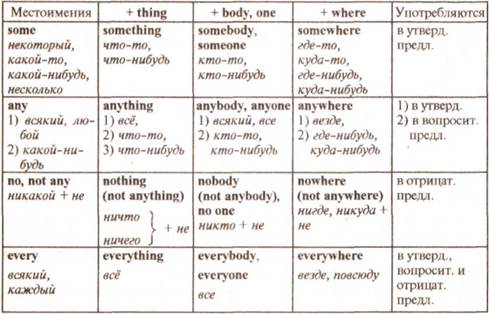
Производные слова от местоимений some, any, по,every
Местоимения some, any, no, everyсо словами thing(вещь), body(субъект), one(некто), where(где, куда) образуют сложные местоимения.
Таблица производных слов от some, any, no, every
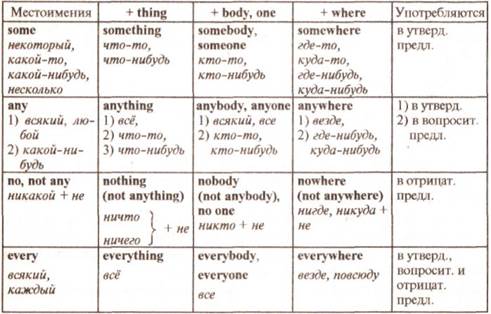
а) Проанализируйте правила употребления неопределенных местоимений, приведенные в таблице, и ознакомьтесь с производными неопределенных местоимений, данными ниже, б) Затем прочтите и переведите текст.
| Местоимение | some | any | nо |
| Утвердительное предложение | — | ||
| Вопросительное предложение | — | — | |
| Отрицательное предложение | — |
somebody anybody nobody
someone anyone no one
something anything nothing
In the Train
Talkative passenger (to a lady who is in the same compartment):
«Have you any family, Madam?»
«Yes, Sir, one son.»
«Does he smoke?»
«No, Sir, he never touches a cigarette.»
«That’s wonderful. Tobacco is poison. Does he belong to any club?»
«He never goes to any.»
«Then I congratulate you. Does he come home late at night?»
«Never. He always goes to bed directly after dinner.»
«He is a model young man, Madam. How old is he?»
«Four months today.»
Переведите следующие предложения, обращая внимание на неопределенные местоимения и их производные.
1. Something important took place there.
2. Nobody failed in this examination yesterday.
3.I wasn’t shown any interesting photographs.
4. Have you got any questions?
5. Can anybody show me the way to the station?
6. He didn’t try to do anything.
7. The commission has found nothing wrong.
8. They made no changes in the working plan.
9. Nothing interesting happened while I was away.
10. No traffic was allowed along the street because of the accident.
11. He could think of nothing really interesting.
12. Some new safety rules were considered by the committee.
13.I couldn’t understand anything from his letter.
14. The old man didn’t get any education.
Дайте полные ответы на следующие вопросы.
1. Is there anything to the right of you?
2. Is there anything to the left of you?
3. Do you have any English books at home?
4. Will you go anywhere tomorrow evening?
5. Can you see anything through the window?
6. Will you bring any English newspaper tomorrow?
7. Do you know any French words?
8. Is there any picture in your room?
9. Are you expecting anybody to come to your place?
10. Did anybody advise you to enter this Institute?
11. Is there anything in the right corner of the room?
12. Is there anybody behind you?
§
Упражнение 1. поставьте глаголы в нужном времени активного залога. sandy (read) historic books every day. what liza (do) now? —
What the point of keeping wild animals at home? First of all, this is good idea to take care of an animal, who can’t take care of itself. It is difficult to find food in today polluted wood, species, that was common some day, now become extinct. If one can possible take care of european wolf or wild cat, it can help restore balance of nature. More over, huge animal may protect house and frighten burglars and neighbors. On the other hand, wild animal will never get used to live at house, it will always dream to break free. There no enough room in modern apartment for them, so they can never run or hunt, as they want. Also, it may be very espensive to keep them, as they need more food and more care, there is less goods for wild animals in pet shops, then for the domestic ones, and finally it would be hard enough to find vet, skilled enough to threat rare animal.
